Table of Contents
- Executive Summary
- Why Heavy Equipment Parts Workflows Are Different
- The Problem With Generic Software
- What Dealer Software Must Handle
- RFQ Management and Quote Speed
- Margin Protection and Pricing Discipline
- Inventory, Supplier, and Sourcing Visibility
- White-Label Dealer Portals
- AI Tools for Parts Operations
- International Exporter and Bid Workflows
- Brand and Equipment Coverage
- Evaluation Checklist
- Implementation Roadmap
- FAQs
- Final Recommendation
Executive Summary
The heavy equipment parts business does not operate like a normal e-commerce business, a generic CRM business, or a simple inventory business. It is a high-pressure, multi-brand, RFQ-driven environment where speed, accuracy, supplier knowledge, customer trust, and margin discipline decide whether a dealer wins or loses.
A customer may ask for one Caterpillar pump, three Komatsu undercarriage parts, a Cummins engine component, Sandvik crusher parts, Epiroc drill components, a Metso wear part, or a mixed list that includes old part numbers, superseded numbers, incomplete descriptions, serial numbers, machine models, photos, and urgent delivery requirements. That is the real world of heavy equipment parts.
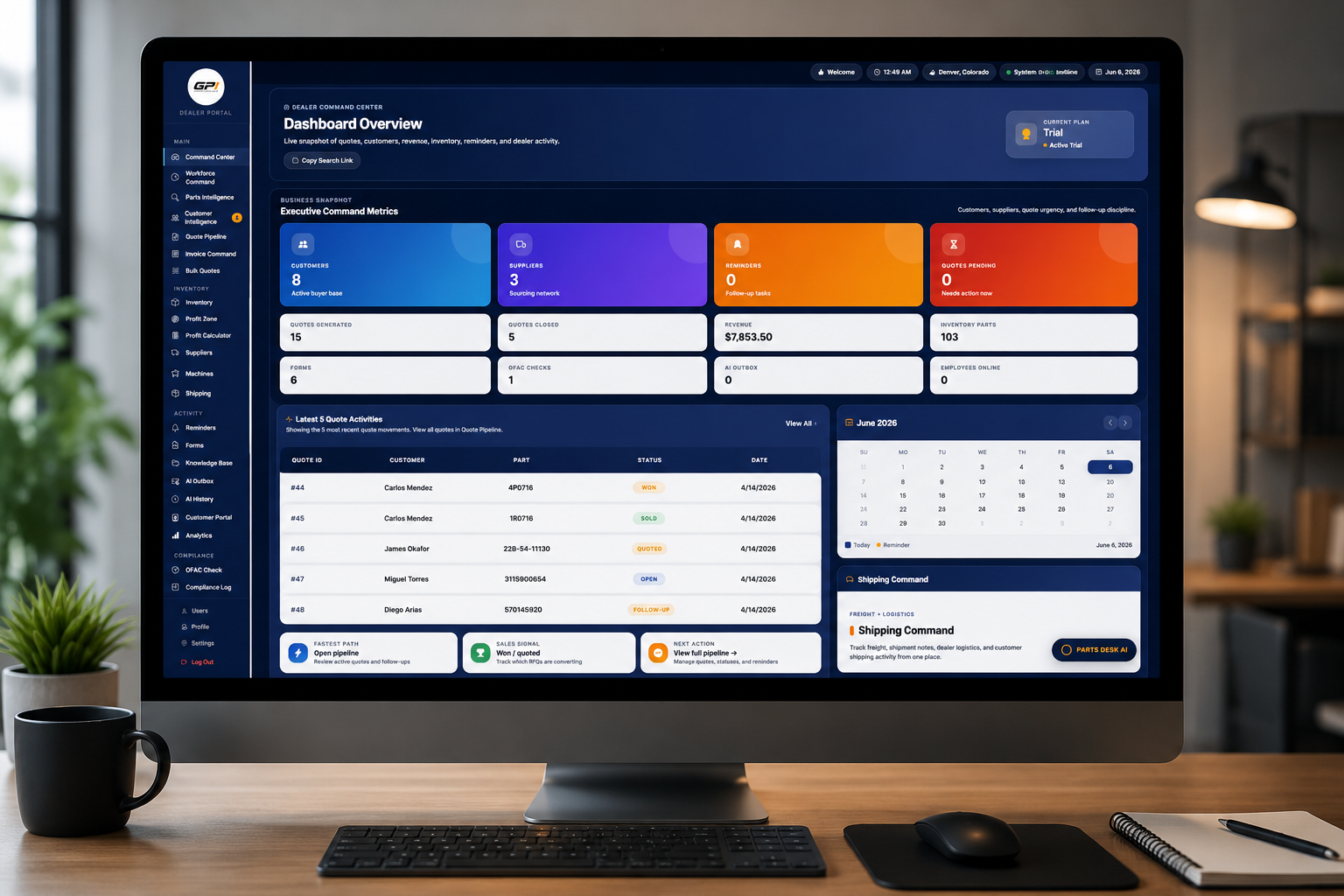
Global Parts Intel was designed around that reality. It is a dealer-built platform for heavy equipment parts dealers, resellers, exporters, and companies that bid on parts requirements. The platform is designed around the operational flow of receiving RFQs, searching inventory, managing suppliers, controlling markup, creating professional quotes, protecting supplier information, capturing customer data, tracking follow-ups, and giving dealers a white-label experience under their own brand.
A serious dealer platform should help the business quote faster, respond more professionally, track every opportunity, protect internal sourcing data, organize inventory, manage supplier intelligence, support international workflows, and make the company look larger and more capable than a spreadsheet-based operation. That is especially important in markets like the United States, South Africa, Australia, the United Kingdom, Ireland, Chile, and Peru.
For a focused explainer on the quoting side, read what a parts quoting system is.
Why Heavy Equipment Parts Workflows Are Different
Heavy equipment parts workflows are complicated because the customer rarely gives the dealer a perfect, clean request. A buyer may send a photo of a worn component, a partial part number, a machine model, a serial number, an old invoice, a handwritten list, or a spreadsheet with dozens of lines. The dealer has to identify what is being requested, confirm whether the part number is current, determine whether there are supersessions, find availability, calculate landed cost, check shipping options, decide margin, prepare a quote, and follow up before a competitor wins the order.
A dealer quoting Caterpillar, Komatsu, Cummins, Sandvik, Epiroc, Metso, Volvo, Hitachi, Liebherr, Atlas Copco, John Deere, Terex, JCB, Case, New Holland, Wirtgen, Kleemann, Doosan, or Develon parts is dealing with high-value equipment, urgent downtime, incomplete information, and buyers who may be comparing several suppliers at the same time. A slow quote can cost the sale. A wrong quote can cost the relationship. A missed follow-up can turn a qualified buyer into someone else's customer.
This is why a normal CRM is not enough. A normal CRM may store contacts and deals, but it usually does not understand part numbers, multi-line RFQs, supplier cost, markup, shipping terms, quote PDFs, branded customer portals, or supplier confidentiality. In this industry, the winner is the dealer that combines speed, accuracy, margin discipline, customer experience, and follow-up.
For a detailed comparison, see GPI vs a general CRM.
The Problem With Generic Software
Many dealers use one tool for CRM, one spreadsheet for inventory, one email inbox for RFQs, one folder for quotes, one messaging app for customer communication, and one person's memory for supplier notes. That setup creates hidden risk.
Lost information. When RFQs live in email and pricing logic lives in a spreadsheet, no one has a complete view of the opportunity. A salesperson may leave the company and take valuable supplier knowledge with them.
Inconsistent pricing. If every salesperson calculates margin differently, the company loses control. Margin leakage can quietly destroy profitability even when revenue looks strong.
Poor customer experience. Buyers notice when a quote looks rushed, inconsistent, or unbranded. In heavy equipment, a professional quote is a trust signal.
Lack of scale. A spreadsheet-based process depends on people remembering what to do. A system-based process creates repeatable behavior that supports growth.
What Dealer Software Must Handle
- RFQ capture: Customers submit part requests through a professional form or portal capturing all required information.
- Quote generation: Dealers create professional, branded quotes quickly without exposing supplier data.
- Margin control: The system applies markup rules and pricing discipline so salespeople quote consistently.
- Inventory and supplier organization: Dealers know what they have, what suppliers they trust, and what supplier notes matter for future quotes.
- Follow-up management: Reminders and quote status tracking so the team knows which opportunities require attention.
- Customer experience: A white-label portal gives the dealer a professional digital front door.
- AI assistance: AI helps the parts professional work faster by reducing repetitive tasks.
RFQ Management and Quote Speed
RFQ speed is one of the most important competitive advantages in the parts business. When a mine, contractor, reseller, exporter, or fleet operator sends a parts requirement, they often send it to more than one supplier. The dealer that responds first with a clear, professional, believable quote has a better chance of controlling the conversation.
But speed without control creates problems. A fast wrong quote is worse than a slow quote. A fast quote with poor margin can win the order and still hurt the company. The goal is to quote fast with structure. Modern RFQ management should allow the dealer to capture requests in one place, assign them to the right person, track status, and move the request toward a quote efficiently.
For exporters and resellers, RFQ management is even more important. A customer may send a bid list with dozens or hundreds of items across Caterpillar, Komatsu, Cummins, Sandvik, Epiroc, Metso, Volvo, Hitachi, or Liebherr parts. Without a structured system, the team can lose track of which lines were quoted and which items still need attention.
Margin Protection and Pricing Discipline
Margin protection is one of the most important reasons to use dedicated dealer software. Revenue can be misleading. A dealer may sell more and still make less if pricing is inconsistent or costs are incomplete.
Heavy equipment parts pricing must consider supplier cost, domestic and international freight, duties, credit card fees, bank fees, packaging, emergency handling, warranty exposure, return risk, and exchange rates. Dedicated software makes margin logic part of the workflow, reducing manual calculation errors and ensuring consistent pricing across the sales team.
Inventory, Supplier, and Sourcing Visibility
A dealer may have stock in its own warehouse, access to supplier stock, old inventory that needs to move, customer returns, consignment items, used parts, rebuilt components, aftermarket options, and OEM options. The challenge is knowing what can be sold profitably and reliably.
Supplier management is equally important. A dealer may know which supplier is reliable for Komatsu parts, which source is strong for Cummins engine components, which supplier handles Sandvik crusher parts, or which contacts are better for Metso aggregate equipment. That knowledge should be structured — not trapped in one person's memory. Sourcing visibility also helps protect the dealer's commercial position by keeping internal supplier data private from customers.
White-Label Dealer Portals
A white-label dealer portal gives the parts business a professional online presence without forcing the dealer to send customers into someone else's brand experience. The dealer owns the customer relationship. The software should support that relationship, not compete with it.
A dealer portal improves data quality. When a customer fills out a guided form, the dealer receives the complete information needed to quote: name, company, email, phone, part number, quantity, model, serial number, notes, and urgency. Better input creates faster output. White-label presentation also helps resellers and exporters compete against larger companies on trust and professionalism.
AI Tools for Parts Operations
AI is becoming useful in heavy equipment parts operations when applied to real workflows. The goal is not to replace the experienced parts professional but to help that professional move faster, organize information better, and reduce repetitive work.
AI can help summarize requests, extract key information, draft internal notes, support customer communication, generate cleaner descriptions, and help structure data for the sales process. However, AI must be used carefully — it should not invent part compatibility, guarantee availability, or make unsupported technical claims. Human review remains important. When paired with a disciplined dealer platform, AI can help the team quote faster and reduce administrative drag.
International Exporter and Bid Workflows
Exporters and companies that bid on parts requirements deal with multiple brands, multiple suppliers, multiple countries, multiple shipping options, and customers who expect clear commercial terms. A bid may include Caterpillar, Komatsu, Cummins, Sandvik, Epiroc, Metso, Volvo, Hitachi, Liebherr, John Deere, Atlas Copco, Terex, JCB, Case, New Holland, Wirtgen, Kleemann, Doosan, or Develon parts in the same requirement.
The exporter must consider availability, lead time, Incoterms, freight, packing, documentation, payment terms, validity, duties, and local regulations. For markets like Chile, Peru, South Africa, and Australia, mining parts requirements can be urgent and complex. The best systems create repeatability: a bid comes in, is captured, assigned, researched, priced, quoted, followed up, and tracked.
Brand and Equipment Coverage
Heavy equipment parts dealers rarely live inside one brand. Many independent dealers, resellers, and exporters support mixed fleets across Caterpillar, Komatsu, Cummins, Sandvik, Epiroc, Metso, Volvo, Hitachi, Liebherr, John Deere, Atlas Copco, Terex, JCB, Case, New Holland, Wirtgen, Kleemann, Doosan, and Develon equipment. The platform should support mixed-brand RFQs, flexible descriptions, and dealer-controlled pricing without rigid catalog limitations.
Evaluation Checklist
- RFQ capture: Can customers submit complete part requests through a structured process?
- Quote generation: Can the dealer produce clean, branded quotes quickly?
- Margin control: Can pricing rules reduce accidental underpricing?
- Supplier management: Can the system store supplier notes and quote intelligence?
- Inventory visibility: Can available stock and old inventory be organized for sales?
- Customer portal: Can the dealer present a professional white-label experience?
- Follow-up reminders: Can the team track open quotes and next actions?
- User management: Can the company add users and control access?
- AI assistance: Can AI support real workflows rather than generic chat only?
- International use: Can the platform support exporters, resellers, and bid requirements?
- Reporting: Can management see activity, quote history, and performance?
- Security mindset: Does the system protect internal data and supplier information?
Implementation Roadmap
- Phase 1 — Quote and RFQ discipline: Capture customer requests cleanly, generate professional quotes, and track quote status.
- Phase 2 — Margin and supplier intelligence: Add pricing rules, supplier notes, and internal sourcing discipline.
- Phase 3 — Customer experience: Launch the white-label dealer portal and improve the customer request process.
- Phase 4 — Inventory and must-go opportunities: Upload inventory, organize old stock, and turn idle inventory into revenue.
- Phase 5 — AI and automation: Add AI support for documents, descriptions, summaries, machine listings, and repetitive tasks.
- Phase 6 — Reporting and scaling: Review quote volume, follow-up activity, win rates, margin patterns, and team performance.
Frequently Asked Questions
Software designed to help parts dealers, resellers, exporters, and RFQ-driven suppliers manage requests, quotes, customers, inventory, suppliers, margins, follow-ups, and branded customer experiences.
A generic CRM tracks contacts and deals. Heavy equipment parts dealer software supports part numbers, RFQs, quote lines, supplier costs, markup, branded quote PDFs, inventory, customer portals, and industry-specific workflows.
Yes. A proper dealer platform supports mixed-brand workflows across Caterpillar, Komatsu, Cummins, Sandvik, Epiroc, Metso, Volvo, Hitachi, Liebherr, John Deere, Atlas Copco, Terex, JCB, Case, New Holland, Wirtgen, Kleemann, Doosan, and Develon, while making clear that brand names belong to their respective owners.
The dealer owns the customer relationship. The customer should interact with the dealer's brand, not a third-party marketplace brand.
No. The best system makes salespeople faster and more organized. It does not replace their industry knowledge, customer relationships, or judgment.
Manual pricing errors and inconsistent markup can quietly reduce profit. A structured platform helps the dealer quote intentionally.
Yes. Exporters need structured RFQ management, supplier notes, international quote terms, customer records, and professional quote presentation.
Yes, if used correctly. AI can help organize requests, summarize information, support document handling, assist with machine listings, and reduce repetitive admin work. Human review remains important.
Final Recommendation
The heavy equipment parts business is becoming more competitive, more digital, and more demanding. The old way — inboxes, spreadsheets, scattered supplier notes, manual quote templates, and memory-based follow-up — can only take a dealer so far. It does not scale cleanly. It creates lost opportunities, inconsistent pricing, weak visibility, and unnecessary stress.
A dealer-built platform designed exclusively for heavy equipment parts businesses gives the company a better operating system. It connects RFQs, quotes, customers, inventory, suppliers, margins, reminders, AI tools, forms, shipping workflows, machine listings, and customer portals into a more disciplined commercial process.
Global Parts Intel is built around the belief that heavy equipment parts businesses deserve software designed for their world: multi-brand, international, urgent, margin-sensitive, relationship-driven, and RFQ-heavy. The dealers that organize now will be better positioned to quote faster, protect profit, serve customers professionally, and grow with confidence.